Showing posts with label Playing Skills. Show all posts

Saturday, November 1, 2014

First Speech Therapy session at Home

Today was the first Speech Therapy session at Home. I am loving it. Really! It is so much better. While she was with Tommy, I could focus 100% on Francis and we had a good time. I also could do laundry! Mrs. F. said Tommy talks and says a lot. So TOMMY IS VERBAL, something we all around Tommy needs to understand. Tommy's issue is that he cannot communicate. He needs to learn that communication is back and force between him and other person. He needs to learn to say all the words he knows in a context while looking at a person rather than randomly when he is running, jumping or on his own, which is very common to see in kids with AUTISM. Mrs. F. has said goals to build his play skills, and then, to communicate.

Working with Mrs. F. is definitely more organized and enticing for Tommy of what I was doing. I will follow her communication routine while playing with Tommy. This will help me to keep working on his play skills for the neuro-developmental program.  I decided to get a professional involved because it was becoming too hard to get Tommy to play with toys. If we met this developmental skills Tommy will be able to keep advancing in the developmental ladder. I feel more empowered now to help him!

THE SKY IS THE LIMIT!

Saturday, May 28, 2011

Our art of blowing —Party Blowers

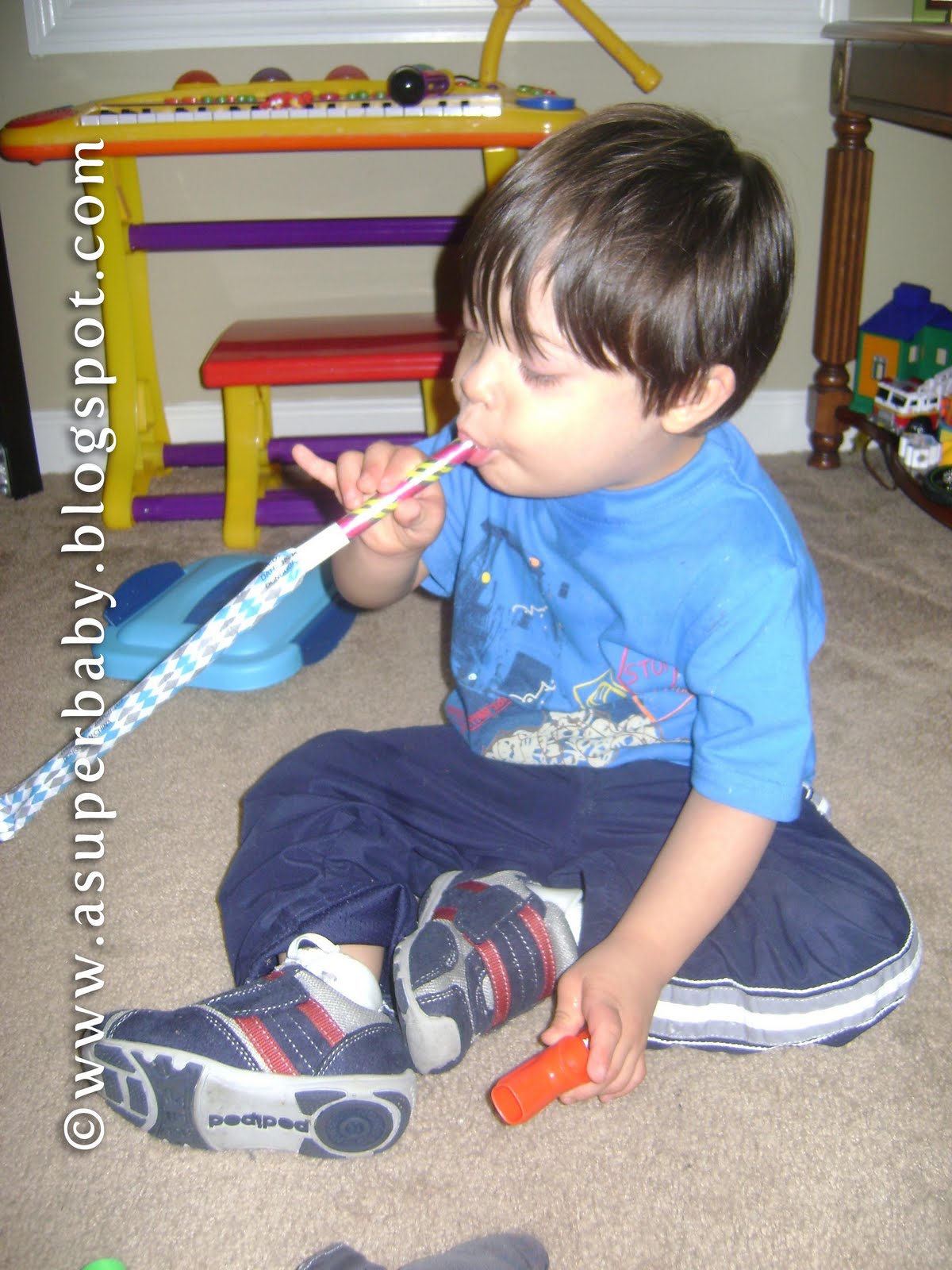
Since Tommy's was very little I encouraged him to drink with a straw and blow whistles and bubbles to strength his oral muscles. I still keep incorporating new blow toys to the art of blowing so he can practice using different complex blow toys that can be found at dollar stores, such as: whistles, party blowers, horns, pipes, bubble blowers, flutes and among others. 

A few months ago, I got party blowers and they were difficult for me to blow, so I put them away because I thought they would be too difficult for Tommy. Yesterday evening, Tommy took his blow toy box and open it. He found the party blowers! I gave him one party blower while I was blowing other one. Then, he blowed the party blower over and over again. I was surprised! Those are quite difficult to blow. I felt my oral muscles working while blowing the party blower. So watching Tommy blowing these party blowers was very impressive because of the fact he has Hypotonia (low muscle tone). He has to work his oral muscles twice harder of what I do. He enjoyed blowing the party blowers and I know for sure his oral muscle are stronger.


Sunday, January 16, 2011

Matching by shape

Shapes recognition and matching will foster a young child's mind to further develop in language, cognitive, social and fine motor skills. It is believed that shapes recognition and matching "play an important role in math performance" (Mazzocco et. al, 2006 pg. 89). Matching is an important skill for young children to develop because it is an essential pre-reading skill.

My son began to match simple jumbo peg puzzles at an appropriate age and matching has become one of his best skills. Our DT brought the Voila Shapes & Shadows Wooden Recognition and Matching Game at the beginning of September. I liked this board game so much that I immediately hunt for this toy.


I like this toy because it has
20 sets of wooden shape and shadow boards to recognize various shapes and match them with the corresponding outlines. Young kids will develop shape recognition while they strengthen their visual memory and fine motor.

Tommy got engage with this game since the beginning I think it is because of the 3D shapes. We currently use two shapes at a time. We will
eventually increase more and more shapes and shadow boards until he can match all the 20 shapes and shadow boards. Tommy puts the shapes aligned with the shadow board sometimes. Other times, he puts the shapes upside down on the right shadow boards or he puts the shapes on the side of the right shadow boards, so we accept it as correct because it is expect at his age.

Enjoy the video of Tommy matching by shape.


Tommy associates the rectangle and square shapes with the iPhone.
At the end of the video, he pretends he talks on the square iPhone
and he handed it to me to talk to daddy on the square iPhone
before matching.

Thursday, December 16, 2010

Pre-scissors skills —Stringing and Lacing


My son walked independently
at his 28-month. During the period he struggled to reach one of the most important gross motor milestones, I knew I couldn't take him to see the world on his own feet. But I knew I could bring the world to his hands. Here it is when I understood how important fine motor skills are for a child's development because fine motor skills support cognition, gross motors, communication and self-care skills. Tommy has always been fine motor driven, so I followed his lead. I helped him to strength his fine muscles, which has allowed him to reach fine motor milestones according to his age.

Tommy and I began to work
occasionally
on stringing large beads by the end of June. Since the beginning, Tommy just needed little help to hold the bead while he was stringing the wooden pole through the bead with the other hand. On August 1st, Tommy stringed three beads by himself for the first time. Tommy accomplished the fine motor milestone of stringing three large beads at his 28 months (age-appropriate).
Currently, we are doing this activity in short period of time during the week or when Tommy feels like to because it is not one of his favorite activities. To make this activity more interesting and fun for him, I make the car sounds when we play with the Alex toy stringing large bead set. I created a home-made stringing set that I named 'caterpillar stringing bead set,' so I tell Tommy the caterpillar is going to get him and he likes to imitate with the beads how the caterpillar moves. Tommy is currently able to string large beads, small beads with big and small holes, as well as, strings with different thickness.


Home-made stringing bead set

I also created home made lacing cards to strength Tommy's fine muscles and eye-hand coordination. I searched on-line for printable lacing cards and I found Activity Village. This website has print ready PDF files with cute animal lacing cards and instructions how to make them. He enjoys this activity, which I also use for language development. He has says "Pull" several times when he is pulling the thread through the hole. Because this in activity for older kids, Tommy put the thread through the holes he prefers.


Lacing cards from ActivityVillage.com

Our OT is very happy that Tommy is fine motor driven. She is very pleased with the progress Tommy has made; therefore, she decreased services for Tommy.


Video of Tommy stringing large beads


Video of Tommy saying 'PULL'

Video of Tommy
stringing small beads


Note: If you are subscribe by email, you may not see the videos. Please visit our blog www.asuperbaby.blogspot.com if you can not see the videos.

Saturday, October 30, 2010

Dealing with the guilt -FREE PLAY

Many parents with their newborns with Trisomy 21 get into crazy schedules for medical appointments and therapies, so some little ones get into a busy schedule right after birth. Parents feel the "guilt" of not doing enough therapies at home or not doing the therapies quite often as it should be because they also work full-time. I has felt this guilt many times, but what has helped me to deal with the guilt is to know that FREE PLAY is as important as structured or guided play for a child brain development.
Dr. John Medina, a Developmental Molecular Biologist, scientist and Director of the Brain Center for Applied Learning Research, says in his book 'The Brain rule for baby': :"We now know that open-ended play activities are as important to a child's neural growth as protein. Indeed, the box the flash-cards come in is probably more beneficial to a toddler's brain that the flash-cards themselves... Studies show that, compared with controls, kids allowed a specific type of open-ended play time were:
• More Creative
• Better at language
• Better at problem solving
• Less stressed
• Better at memory
• More socially skilled"

Dr. Jill Stamm also mention the importance of FREE PLAY in his book Bright from the star (this book was based on science research). She says:"So I love the moment when I explain that child's FREE PLAY" is critical because it actually causes the brain's energy to be used in a different way –because the pleasure it brings causes repetition, play reinforces healthy wiring. Play suddenly stops being some kind of iddle time -waster in their eyes. It's elevated to the status of something vitally important for their child to do. (As it should be!)...
Here are three kinds of unstructured time —what I call "sloppy time: —that a child should have every day:
Undirected Play: ... don't need to "direct the action" all the time. Create a child-safe space where your little one can freely explore. Fill it with interesting objects, from basic toys to books to household objects, that he can manipulate at his own pace. Certainly some direct play (Chapter 4) is importnat. But so is free play.
Hanging out: We would sometimes lie down and play made-up games... And share lots of giggles when we thought we had stumped the other. Giggling is good for any brain.
Watching the wold go by: Sitting in a stroller or grocery cart are perfect examples of opportunities for a child's mind to wander... This frees the child to look at colors, shapes going by, watch people, or pay attention to nothing in particular. His brain can spend its time consolidating prior stimuli because it doesn't need to concentrate especially hard on what's in front of him."

"A new report from the American Academy of Pediatrics (AAP) says free and unstructured play is healthy and - in fact - essential for helping children reach important social, emotional, and cognitive developmental milestones as well as helping them manage stress and become resilient. The report, " The Importance of Play in Promoting Healthy Child Development and Maintaining Strong Parent-Child Bonds. ," is written in defense of play and in response to forces threatening free play and unscheduled time..."
Doing therapies thru play (structure play) is important for our kids with Trisomy 21, but giving them FREE TIME for playing should be important, too. They discover the world around them by exploring on their own. I also see it as a way to inculcate 'independency' at a very young age because during free play they make choices about what toy to play with or what area they haven't explored enough. Our son has free play time and during this time he is physically active, which it is very important because it helps him to get his muscles stronger while he discovers the world around him.

Encouraging the desire to explore should be in a safe environment, so design a play room is the ideal, but if this not possible save-proof the house and transform it in a big play house, it is what I have done for my son. I changed my decorative items for toys, household items, books, balls, pretend play toys, and so on. I periodically rotate the toys around the house to encourage exploration and novelty. I sets his toys in different areas so he is free to explore and find them in his own schedule without direction from us. This keeps him busy until lunch. After lunch, he takes his nap and when I get from work we often work on structured play based on his therapies for a short period of time. Fee play should be with supervision. For example: My son turned the stove knobs and he was able to turned the stove on. He also discovered how to open the oven. He climbed on the oven door and was getting ready to see what was on the stove and the stove was on. We closely supervise him, therefore these two moments didn't become in serious situations.

I enjoy watching him when he learns to do things from our structured play, but I enjoy more when he discovers how to do things on his own. For example: Last week, he was playing with a Tupperware container for about two hours and he suddenly discovered how to seal the lid. Now, when we play with play-dough, he helps to close the containers.

Welcome to Tommy's World


Tommy vs. Daddy
Rough housing play is an excellent way of FREE play
while parents bound with their kids.

"Giggling is good for any brain."


A Basketball ring can be a necklace
in Tommy's world


Anything can be a hat in Tommy's world.
OLD VHC Box of the movie Titanic

In Tommy's world, Huggie swimmer pants can be wore on
your pants and not underneath.

I want my son enjoy everything as a child regardless his
developmental challenges. I am glad that my husband and I have
fund the balance between FREE PLAY and structured play.

Saturday, August 28, 2010

Let's Pretend (Part 3)

Two months ago, I posted about how my son was playing dress-up; even although, he wasn't walking yet. After two months, he keeps enjoying dress-up and the best of all, I enjoy watching him walking around playing with his dress-up toys.

Tommy came to my room this morning and found the cap from my wonder woman costume. He was playing with it and I thought he could wear it. We watched a Superman cartoon I found in You Tube to help him to understand who was the person I was telling him he was. Because he hasn't seen any Superman movies before. He liked the cartoon! He smiled at me every time I said:
"Here comes the Superman." So, I asked to him "Who is Superman?" and he signed "me." It was the best I could do for him today. He wore the cap until nap time.

He has exceed our expectations since he was in the womb.
We don't know what the future grants for him,
but we will be there for him in every single stage of his life.
He is my little Superman!


Video of Tommy playing dress up
Finally, I could film Tommy putting his sunglasses on.
I was trying to do it since I got hi sunglasses in May
because he likes it so much, but I kept forgetting it.
He also likes to put his Aloha necklace on
crossing his chest,
so he has his own fashion style.


I am currently creating a dress-up box for Tommy. My mother-in-law gave him a dress-up box and I have gotten a few more items, but I still have to work more on this project. As soon as, it is done I will post a photo.


Related Articles:
  1. Tommy, "The Boxer"
  2. Tommy's pretend play skills
  3. Let's pretend
  4. Let's pretend (Part 2)

Thursday, August 26, 2010

Pouring -Pre-writing skill (Part 1)

Pouring seems to be a very simple activity, but for kids with low muscle tone means their pathway to handwriting because it helps to develop eye-hand coordination. Handwriting is an essential skill to learn in the early school years.

Pouring water is a fun activity for Tommy thanks to the measure cups my mother-in-law gave to him for his first Christmas. The best time to incorporate this activity in the daily routine is during bath time, specially, for full time working moms like me. The best age to introduce this activity to the child is when he or she is still a baby around 10-12 months. I used to just throw the measure cups in the bathtub and let my son to explored them. Later, I started demonstrating him how to scoop with the cups without making him to do it. I just did it for a few seconds while he observed me. Eventually, he started to pour by himself.

Tommy is currently working on pouring from one cup to the other and he is having so much fun because he laughs when he spills the water. I don't expect him to be able to pour the water from one cup to the other one because this is an activity for 3-year old kids, but he is an age appropriate to introduce the concept. Meanwhile, we are just having fun!

Tommy's toys for pre-writing skills
  • Measure Up!® Cups by Discovery Toys: We use this set of cups to scoop, dump, fill, nest, stack, sort, count and introduce concepts related to color, size and volume. This cups can also be used as play-dough stampers.
  • Fish Cup: I got this cup in Babies' R Us and it is an inexpensive cup, but it multiplies his value for the hours of fun that my son has by playing with his fishy cup.
  • Sand & Water Mill: I got this toy at target for just $1.oo. This an excellent price, but it also multiples his value because my son's eye hand coordination is getting better and better after he plays with this toy.
Tommy began to pour
(1-year old)


Tommy pours in a more complex way
(2-year old)

Tuesday, August 24, 2010

Early Math Skills -"different" and "same"

The concepts of "different" and "same" are math concepts that will be used in later school years; therefore, they are considered critical first steps in learning to classify objects based on their visual characteristics. Our DT suggested to introduce these concepts to my son after he showed proficiency in matching.

Tommy got engaged with these activities since the first time I introduced it to him. I started playing the games What's different? and What's the same? with stuffed animals and animal figurines, which keep Tommy engages with the activity. We also play What's different? and What's the same? with the memory game Teddy Mix & match by Ravensburger, which is a memory game for ages from 2 1/2 to 5. We have also incorporated household items into the game to support Tommy's language development.

What's different? Game

What's the same? Game


The Teddy Mix & Match is an ideal beginner's memory game.
The large, extra thick cards are perfect for little hands.
It is a fun way to develop recognition, observation, association,
memory, and social skills by just playing with this memory game.
The graphics are well done that keep Tommy delights while we play.

Sunday, August 8, 2010

Music enriches language development

I am exploring every possible way to stimulate my son in every aspect of his development. My desire to help him, as much as I can, has brought me to find useful information that is molding the way I teach him, such as: Born to Sing: How Music Enriches Children's Language Development by Ann Gadzikowski, former Grants Coordinator, Chicago Children's Museum. Below is a fragment of the article:
When I was a preschool teacher, I had a child named Lizzy in one of my classes. She rarely spoke. At three years old, Lizzy usually communicated with me by tugging on my sleeve and pointing her finger at what she wanted. Yet I wasnít at all worried about Lizzy. My confidence in her was so strong because I knew there would be at least one time every day when I would be sure to hear her voiceóduring music time. Quiet Lizzy came alive whenever she heard music. She clapped, she danced, she even sang along to class favorites such as "The Wheels on the Bus" and "This Old Man." Her favorite song was "Where is Thumbkin?"

Eventually, Lizzy did begin to speak and soon was able to talk and communicate like other kids her age. She taught me that music is a powerful tool for giving a voice to a quiet child.

All children benefit from experiences with music. Music enhances learning, especially language development. Children's experiences with music build vocabulary, listening skills, and language acquisition.

Parenting is not that easy, but it is fun! Having my child has made part of my childhood comes back. I think I am experiencing a second childhood through my son with the American style. He will go to pre-school next year and I want him to be familiar with the popular American children songs.
So, I have to learn the songs to sign to my son because I wasn't born in the USA I am not familiar with popular children's songs.

I got a radio for Tommy a couple of months ago because the ones he had where for babies and they were to basic for him. I started my search and I found The Little Tunes MP3 player by Blue hat Toy Company. The sound quality is good because it is not too loud and even the highest volume decibel. The bottoms are toddler friendly, which make it fun for Tommy because he turns the volume up and down, turns it off and on, and switches the songs. It can be used with headphones and download music to the radio.This is a real radio!

After I got the radio, I didn't know the songs. Then, I began to search for lyrics and I found
www.kididdles.com, the best in children's music. In this website, you can find songs to listen to with the lyrics to read. They have a selection of 2,000 of the most popular children's songs, organized by alphabetical and subject order. It also has free download for the song sheets and music sheets.

The little Tunes radio and www.kididdles.com
are the perfect combination for hours of fun.
Tommy and I are learning the song
Six little ducks.

Six little ducks .mp3


Found at bee mp3 search engine

Sunday, July 4, 2010

"Let's pretend" (Part 2)

In my last post about Dress-up, I didn't have a video of Tommy playing dress-up. But during the weekend I could capture him with my video camera playing dress-up in front of the mirror. Dress-up has became part of his play time in a natural way without therapies, one more thing he has done on his own. When Tommy looks straight to my eyes I can hear his soul telling me "Mommy believe in me."

Thursday, July 1, 2010

"Let's pretend"

"For those who played make-believe as a child,
consider yourself lucky. According to Laura Berk,
the visiting psychology lecturer from Illinois State University,
children who play make-believe are better
and more prepared for the academic and social world."

"Pretend play also promotes abstract thinking.
The ability to use a prop (such as a block) as a symbol for
something else (such as a phone) is a high-level thinking skill.
Eventually it will enable your child to recognize that
numbers represent quantities of things, and that combinations
of letters represent the words she speaks, hears, and reads."

When one think about dress-up play, one imagine toddlers jumping and running dressing funny outfits. Raising my child with T21 has let me be witness that dress-up play can be a fun time for a child who has gross motor difficulties because of a genetic condition. We are supporting every single aspect of our son's development by giving him the opportunity of enjoying life as any other child; therefore, make-believe play is important for his cognitive skills.

My 28 month old boy plays dress-up regardless his level of gross motor skills. He is in the first stage of dress-up play. We have created a little area for him for dress-up play. We put a mirror with a little box with two hats, party bead necklace, sunglasses, an old t-shirt, a doll and a dress-up bear. My son favorite dress-up items are the hats, party bead necklaces and sunglasses. He likes to see at him-self in the mirror when he is wearing the hats. He moves the hats around his head and look at both sides to make sure he looks good. He likes to wear the sunglasses and crawl around while he point at them, it is his way to show them to me. I love to look at his face when he is wearing his sunglasses because he looks at me like an older guy, as shown in the photo below.


He has invited his plush animal "El Tucán" to play dress-up with him.
He put the party bead neckless around the toucan.


Creating a dress-up box for girls it is easier than for boys. I am currently looking for new items and costumes, I can adjust to my child gross motor skills while he can continue strengthening his make-believe play skills. It is becoming a very fun project for me. I will post a second article talking about what Items one can include in a dress-up play box for boys.


Friday, June 11, 2010

The Color of Hope

One of my favorite song is "Color Esperanza" by Diego Torres (The color of hope).
This song means a lot to me because I came to the USA in pursuing
my master's degree with the hope for a better future. Six years later,
I am living in this wonderful country with my husband and my
child who is the color of hope, for every milestones he accomplishes
and for every challenge he surpasses.

Color Esperanza by Diego Torres
"In 2003, the song was performed specially by Torres for the
by the festival of the Youth, for to welcome the Pope."~Wikipedia.com

Colors means a lot in my life because the graphic art is one of my best skills since I remember. Now, I welcome my son to my world by teaching him about colors. I introduced colors to Tommy when he was about 15-month old for strengthening Tommy's attention span. Tommy and I used to drop stacking cups and foam letters grouped by color in the bathtub (A color per week). While we dropped the cups, I labeled the color in English and Spanish.

I bought a set of flash cards and it comes with color cards. Then, I started to show the cards to Tommy and telling him: pick the green, pick the yellow. He did pick the correct color every time I asked. It made realize how capable my son is, but Tommy was 16.5 month old; so, I decided to work on this activity when he was older. Our Speech therapist, at that time, was witness of this and she was very impressed.

According to the article 'Why Colors and Shapes Matter' by Ellen Booth Church, Color is one of the first ways your preschooler makes distinctions among things she sees; color words are some of the first words she uses to describe these things. You have probably heard the pride in your child's voice as she names the colors of the balloons at the store checkout, or her delight when she realizes that a banana and pear are different shades of yellow... But there is much more to your child's understanding of color than "knowing his colors." While it is important for him to know the names of the colors, it is just as important for him to know what to do with them. You can help by inviting him to notice many shades, hues, and tints. Make up names for these colors together, such as lemon yellow or apple red. You will be helping him use color as a means for creative thinking and language.

Tommy is in the age appropriate to work on sorting, matching and recognition of colors. As a mommy-teacher, I have found easier to teach the primary colors first in the following order: yellow, green, red and blue. Now that my son is older, I am introducing two colors at a time, but they should contrast because it is easier for the child to notice the deference between them. For example: I am teaching the colors black and white to Tommy, the contrast between those two colors is very noticeable. If we are going to use the primary colors, I always use yellow as the contrasting color of the color I am working on.

His developmental Therapist introduced sorting by color to Tommy when he was about 23 month. He began to sort by color with me when he turned 24 month. We have toys we use for sorting by color, which also are for developing eye-hand coordination. And, we recently retake the activity of colors with flash cards and Tommy likes to match by color with the flash cards.

Tommy seems to have aptitude of graphic artist (ha, ha, ha, like mommy). I think is a great skill to develop in any child because it is a long lasting skill that can be pursued any where in the world and they can do it for leaving.

Enjoy the video of Tommy working with colors.

A Fragment of the song "Color Esperanza"
Translation:
“...Knowing that is possible, desiring that can be
Removing the fears, taking them off
Painting the face with the color of hope
Tempting to the future with the heart

It's better to be lost than never to embark
It's better to attempt to stop trying
Even although, you see that the beginning is not easy
The impossible can be achieved
The sadness will go on some day
and thus will be, life changes and will change

You'll feel that your soul flies
for singing one more time..."